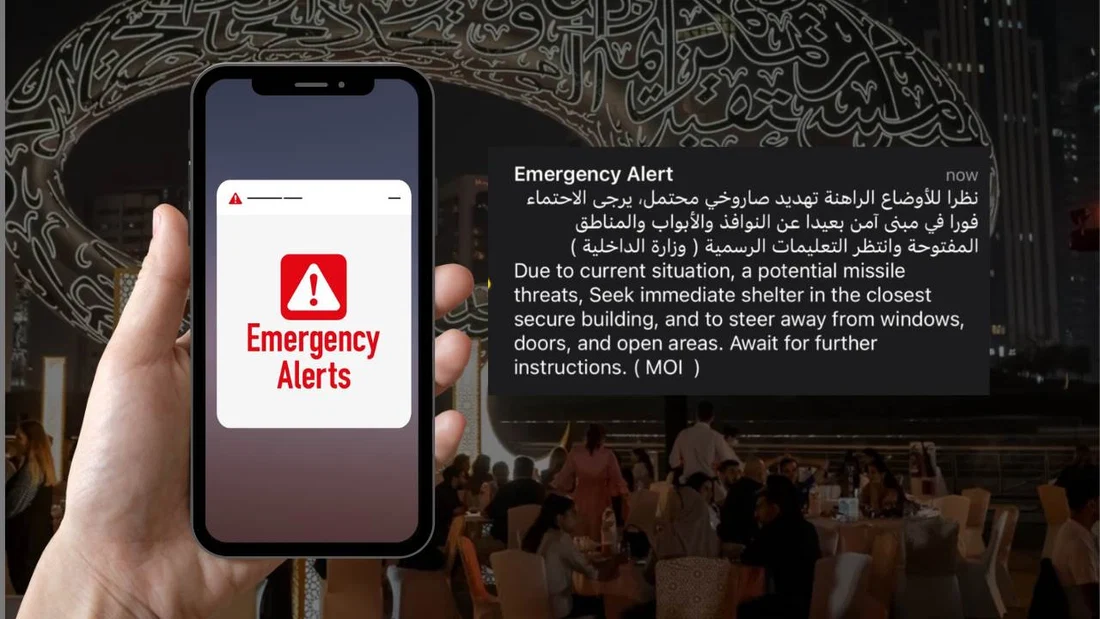
Overview
UAE mobile alerts are designed to deliver urgent, location-relevant instructions. The correct response is to read the entire message, identify the affected area and comply with the stated action. When sheltering is ordered, NCEMA advises moving to a safe place away from windows, doors and open areas until an all-clear.
What matters
The alert itself is more important than a generic social-media checklist. Verify updates through UAE Government, NCEMA, Dubai Police and official weather channels. Keep emergency numbers for genuine emergencies, avoid sharing rumours or incident imagery, and make a simple family plan before a warning occurs.
Practical checklist
- 01Read every line
Identify the issuer, affected area, hazard, time window and requested action.
- 02Follow the specific instruction
Shelter, evacuate, reroute or wait exactly as the authorised message directs.
- 03Move away from exterior glass
When sheltering is ordered, choose a protected area away from windows, doors and open spaces.
- 04Check official updates
Use NCEMA, Dubai Police, the UAE Government portal and official weather warnings.
- 05Contact family briefly
Confirm safety by message and keep networks clear for emergency communication.
- 06Use the right number
Save 999 police, 998 ambulance, 997 fire or Civil Defence and 901 for Dubai Police non-emergencies.
- 07Prepare a home kit
Keep medication, first aid, a torch, power, water and household-specific essentials ready.
- 08Wait for the all-clear
Do not leave a safe place because the first alert sound or visible incident has stopped.
Our method
We selected this topic after checking the complete Archive 971 article library for overlap. The article uses Time Out Dubai only as a discovery signal. Every safety instruction, contact number and system description was independently checked against current UAE Government, NCEMA, Dubai Police and official weather resources on 19 August 2026. We distinguish general preparedness from hazard-specific directions and give the live alert priority.
What to do in the first minute
Stop and read the whole alert before tapping it away. Identify the issuing authority, the location covered, the hazard, the time window and the action requested. A warning may apply only to a district, road, coastline or weather area, so do not assume that a dramatic sound means the same instruction everywhere.
Follow the message itself before any general checklist. If the alert says to shelter, evacuate, avoid a road, stay away from the coast or wait for an all-clear, that specific instruction takes priority. UAE authorities use mobile warnings to deliver time-sensitive directions, and the safest response is usually calm compliance rather than trying to investigate the incident.
If you are driving, do not read a long message while the vehicle is moving. Reduce speed safely, follow police or road signs and stop in a permitted place before checking details. Never stop in a live traffic lane or beneath a bridge simply to use the phone.
What is the UAE Early Warning System?
The UAE Early Warning System is a public-safety system that allows authorised authorities to send location-relevant warnings to mobile phones. The UAE Government describes it as a way to warn people about dangerous weather and provide procedures to follow. NCEMA says the system is intended to preserve life and property, reduce the effects of an emergency and reach large numbers of people quickly.
An alert can be loud or visually prominent because it is designed to get attention. It may be a test, an advisory or an urgent warning. Read the label and the message rather than judging the risk from the sound alone. Do not disable emergency alerts simply because a test or previous warning was inconvenient; device menus and mandatory-alert settings differ by phone and network.
If the alert tells you to take shelter
NCEMA's current public guidance says that, when an early warning instructs people to take shelter, they should move to a safe place and stay away from windows, doors and open areas until an all-clear is announced. In a typical apartment or office, that usually means moving indoors to a more protected internal area and keeping away from exterior glass.
Close doors and windows if it is safe to do so. Bring children, older relatives, People of Determination and pets with you. Take essential medication, a charged phone and a power bank, but do not delay sheltering to collect non-essential belongings.
Do not automatically use a basement, lift, underground car park or stairwell unless the alert or building authority identifies it as safe. The right location depends on the hazard. Flooding, fire, smoke, severe weather and other emergencies require different choices. Follow the exact alert, building management and emergency-service instructions.
Wait for an official all-clear
Do not leave shelter because the first noise has stopped or social media appears calm. NCEMA advises remaining in the safe place until an all-clear is announced. A second message may update the affected area, extend the warning or change the required action.
Keep the phone audible enough to receive updates and conserve battery. Use messages rather than repeated calls to family when mobile networks are busy. If everyone is safe, avoid calling emergency lines merely to ask what the alert means; check official channels first.
How to verify an alert and get updates
Use primary government channels: NCEMA for national emergency information, Dubai Police for Dubai safety and policing updates, the National Center of Meteorology for weather warnings, and the UAE Government portal for emergency guidance. Emirates News Agency is the UAE Government's official news agency and can be useful for confirmed national announcements.
Do not rely on a forwarded voice note, cropped screenshot or anonymous account. NCEMA has repeatedly asked the public to rely on official sources and avoid spreading rumours. Current NCEMA safety guidance also says not to photograph or publish images showing incident locations or damage where doing so could cause panic or create a security risk.
Share the official link or announcement instead of rewriting it from memory. Check the date and time because an old warning can resurface during a new event. If an image or message has no identifiable authority, treat it as unverified until an official channel confirms it.
Dubai emergency numbers to save
Call 999 for an immediate police emergency, 998 for an ambulance and 997 for fire or Civil Defence. Dubai Police lists 901 for non-emergency enquiries and services. Use 999 only when urgent police assistance is needed so emergency operators remain available for people in danger.
When calling, state the nature of the emergency, the exact location, a nearby landmark or building name, the number of people affected and a callback number. Follow the operator's questions and do not hang up until instructed. If your building has security or reception, alert them after contacting the correct emergency service—not instead of it when life or safety is at risk.
Prepare before the next alert
Choose a family contact and agree how everyone will confirm they are safe. Know how children will be collected if schools issue instructions and who will assist a relative who needs medication or mobility support. Save building security, school and workplace emergency contacts separately from public emergency numbers.
NCEMA recommends keeping emergency and first-aid bags ready. A practical home kit can include prescribed medication, basic first-aid supplies, a torch, spare batteries, a charged power bank, drinking water and essential identification or contact information. Adapt the kit to infants, older people, People of Determination and pets in the household.
Check smoke alarms, keep exits clear and know where the building assembly point is. Preparation should support official instructions, not encourage self-deployment toward an incident.
Weather alerts need hazard-specific decisions
For heavy rain or flooding, follow closure notices and do not drive into standing or moving water. For dust, sand or severe wind, secure loose balcony items when it is safe and close windows. For lightning, avoid exposed outdoor areas. These are general precautions; the current alert, National Center of Meteorology warnings and local authority instructions are the final guide.
The UAE Government's weather portal links live warnings for hazards including floods, tropical systems and other environmental conditions. Check it before a journey when conditions are changing, especially if the route includes wadis, low-lying roads, the coast or mountain areas.
What not to do after receiving an alert
Do not travel toward the affected area, crowd emergency routes or launch a drone. Do not post precise incident locations, security activity, casualties or unverified damage. Do not call emergency numbers for routine information, and do not assume a message is false simply because people nearby did not receive the same wording.
The useful response is simple: read, comply, shelter or reroute as instructed, monitor official updates and wait for the all-clear. A calm household plan made in advance prevents rushed decisions when the phone sounds.
Frequently asked questions
Why did my phone receive a UAE emergency alert?+
Authorised authorities use the UAE Early Warning System to send location-relevant safety warnings and instructions. Read the issuer, area, hazard and requested action in the message.
What should I do if the alert says take shelter?+
NCEMA advises moving to a safe place away from windows, doors and open areas and remaining there until an official all-clear is announced.
Should I call 999 to ask what an alert means?+
No, unless there is an immediate police emergency. Check official government updates for information; Dubai Police 901 handles non-emergency enquiries.
What are the main Dubai emergency numbers?+
Use 999 for police, 998 for ambulance and 997 for fire or Civil Defence. Give the exact location and follow the operator's questions.
How can I tell whether a forwarded alert is real?+
Check the issuing authority, timestamp and location against NCEMA, UAE Government, Dubai Police or official weather channels. Do not rely on anonymous screenshots or voice notes.
Should I share photos of an incident?+
No. NCEMA guidance warns against photographing or publishing incident locations or damage where this may cause panic or create a security concern. Share official announcements instead.
Can I turn off UAE emergency alerts?+
Do not disable safety alerts simply because a previous warning was inconvenient. Phone and network settings vary, and some alert classes may be mandatory. Keep the device able to receive official instructions.
What should be in a UAE home emergency kit?+
Start with prescribed medication, first-aid supplies, a torch, spare batteries, a power bank, drinking water and essential identification or contacts, then adapt it for children, older people, People of Determination and pets.
Sources & verification
We prioritise primary and authoritative sources. Prices, availability and rules can change, so reconfirm important details before acting.
- UAE Government — Handling emergencies
- NCEMA — Latest public safety guidance
- NCEMA — Mobile Early Warning System
- Dubai Police — Contact and emergency numbers
- UAE Government — Weather conditions and environmental status
- NCEMA — General emergency awareness
- Featured image — Tony Webster / Wikimedia Commons, CC BY 2.0


